Discover

Every AI agent, accounted for.

AI agents now make decisions your company is liable for — at machine speed, across vendors, often without anyone watching. Discover is the inventory motion: find every tool, model, and agent in use, and put each under a named owner.

78%
of enterprises unprepared for EU AI Act — over half lack an AI inventory
6+
Discovery signal sources
5
Lifecycle states per discovery
CycloneDX
AI SBOM standard

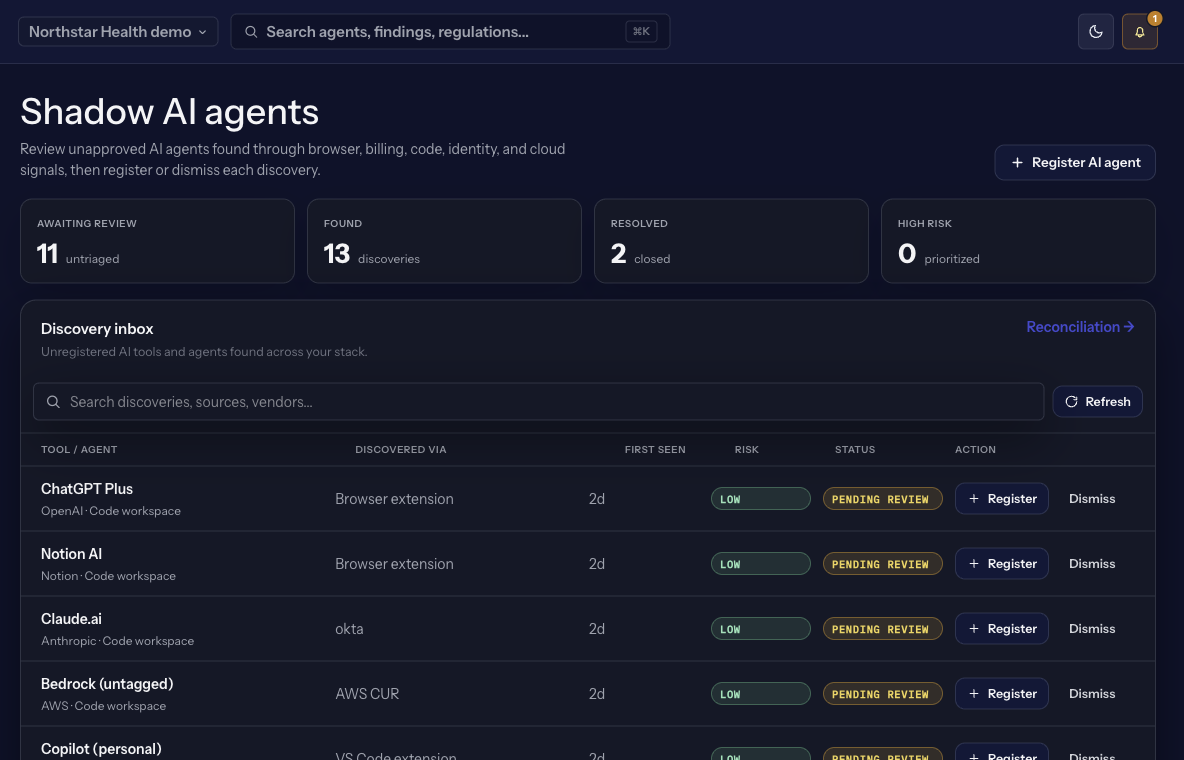
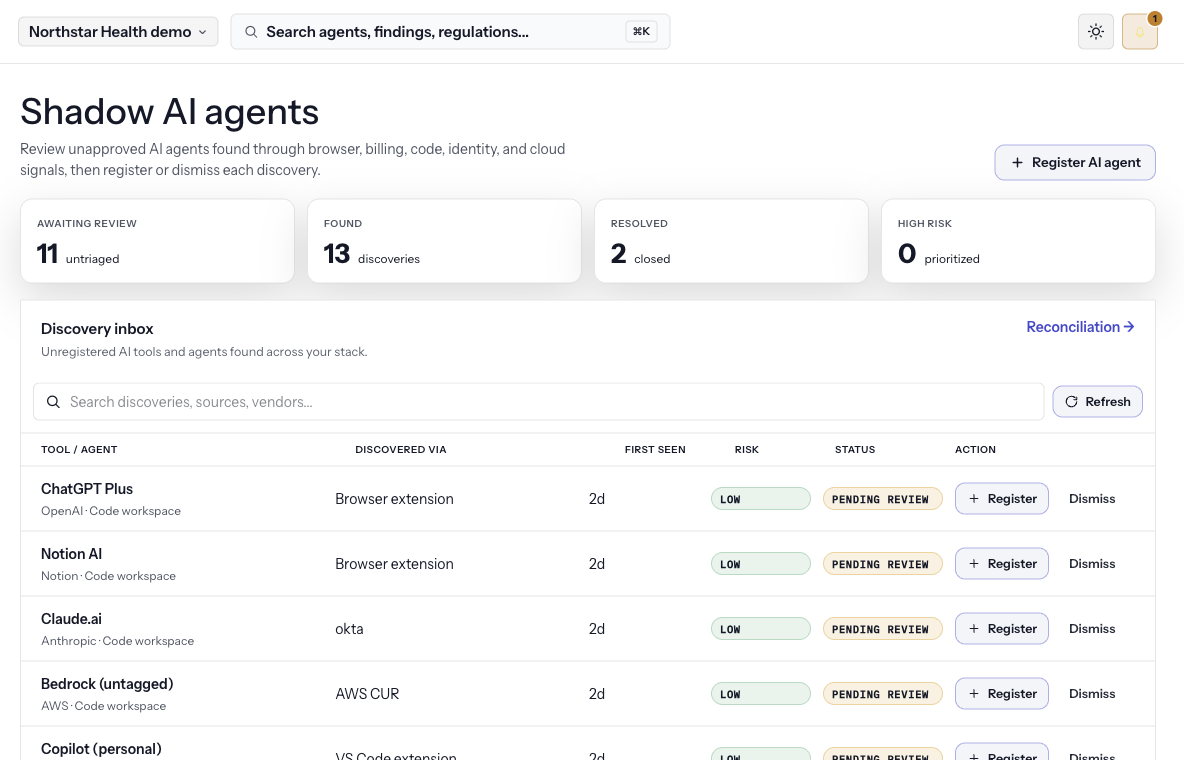
Shadow AI Discovery

Automatic detection of AI in use across the organization — ChatGPT, Claude, Gemini, copilots, and the agents developers spin up without a procurement touchpoint — surfaced as governance gaps for review.

Multi-vendor chaos is the privacy risk that shows up on every enterprise deployment: dozens of agents, vendors, and models — and when Agent A calls Agent B via MCP, who owns the output? Multi-source discovery avoids single-signal blind spots.
Designed against — EU AI Act Art. 28
In the app — /shadow-ai · /shadow-ai/import · /shadow-ai/library · /shadow-ai/reconciliation
Cloud billing & SaaS admin signals
AI spend and usage surfaced from cloud cost streams and SaaS admin consoles.
Identity provider & browser telemetry
SCIM signals plus a Chrome extension that sees shadow AI where it's actually used — the browser.
Workspace AI scanners
M365 Copilot audit logs, Slack AI app catalog, Notion AI usage, and OpenAI admin scanning.
Agent-level discovery
The Shadow Agent Sentinel scans MCP registries and inspects A2A senders — agents most platforms miss.
Reconciliation & resolution log
Every discovery moves discovered → under review → registered, accepted-risk, or blocked — with the decision trail kept.
korasafe.ai/shadow-ai
Shadow AI discovery across ChatGPT, Claude, Gemini, and copilots

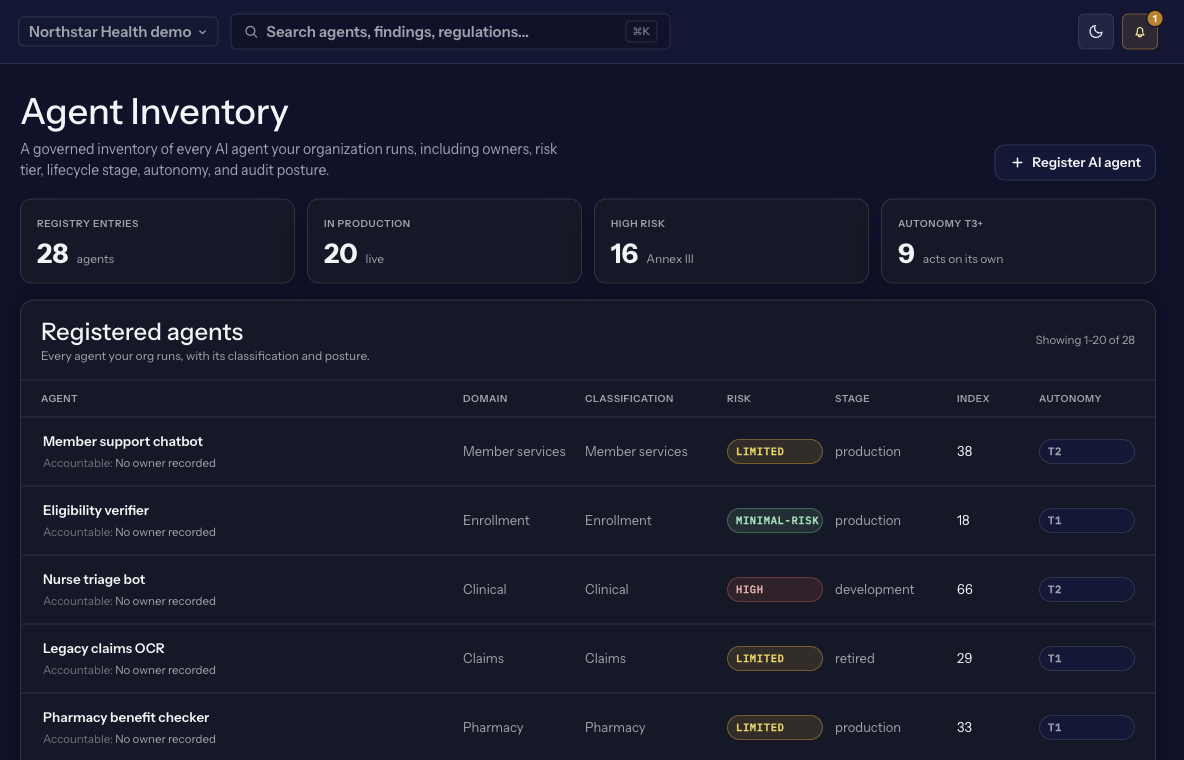
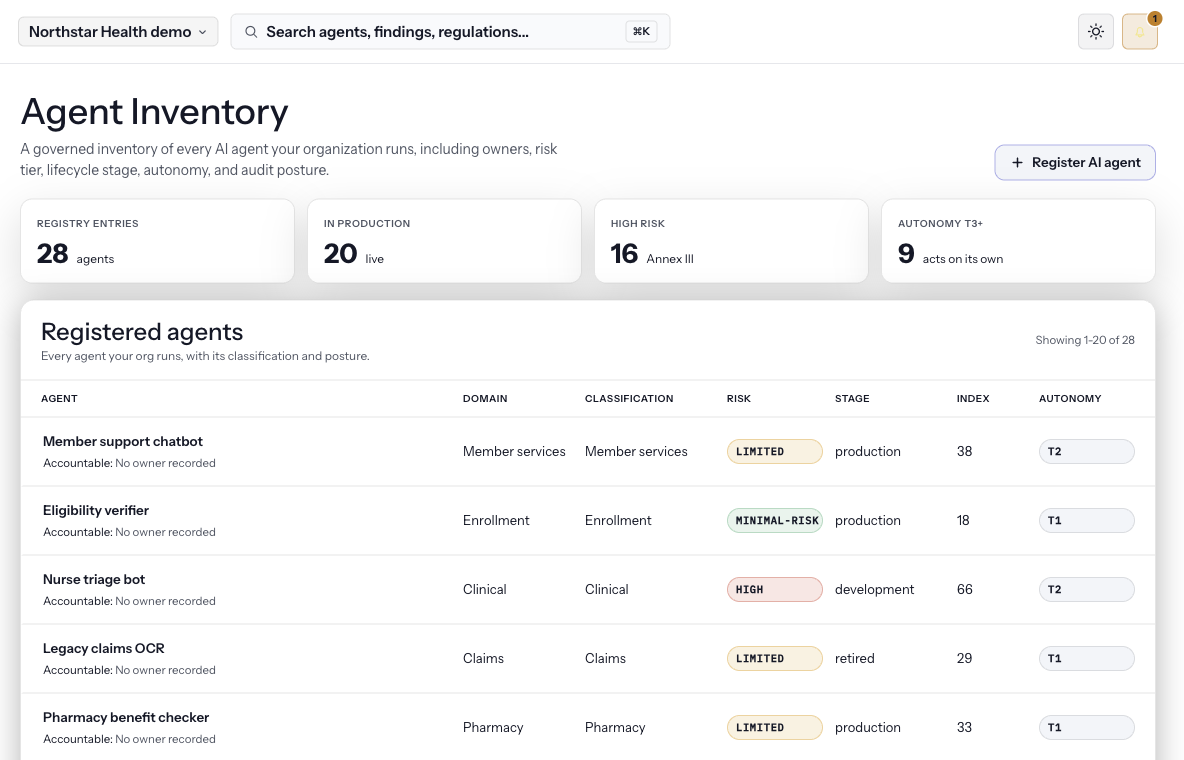
AI Agent Inventory

Every system catalogued, risk-classified, and lifecycle-tracked. One registry for every AI system and agent — its owner, autonomy tier, and data-class footprint — the record everything else attaches to.

KoraSafe™ is built around the agent. Policies, risk scores, findings, and evidence all hang off the inventory record, so accountability is never ambiguous: every agent has a name next to it.

Designed against — EU AI Act Art. 9 · ISO 42001 Cl. 6.1
In the app — /inventory/registry · /systems · /agents · /inventory/lifecycle
Registration with autonomy tiers
Sector, jurisdiction, use case, data classes, output type, and declared autonomy ceiling.
Named ownership & RACI
Every agent carries an accountable owner, team, and runbook — no orphaned systems.
Agent Lifecycle Watch
Continuous monitoring keeps the registry honest as agents change, retire, or multiply.
In the developer workflow
VS Code and JetBrains extensions prompt inline registration as engineers commit AI code.
korasafe.ai/inventory/registry
AI registry: every system catalogued, risk-classified, lifecycle-tracked

Supply Chain Visibility

An AI bill of materials for every registered system — base models, datasets, inference libraries, vendor APIs, and RAG sources — with continuous vulnerability scanning and vendor risk scoring.

AI libraries carry real CVEs, and most security teams don't scan them with the rigor applied to application dependencies. KoraSafe™ generates the documentation regulators point toward and watches it continuously.
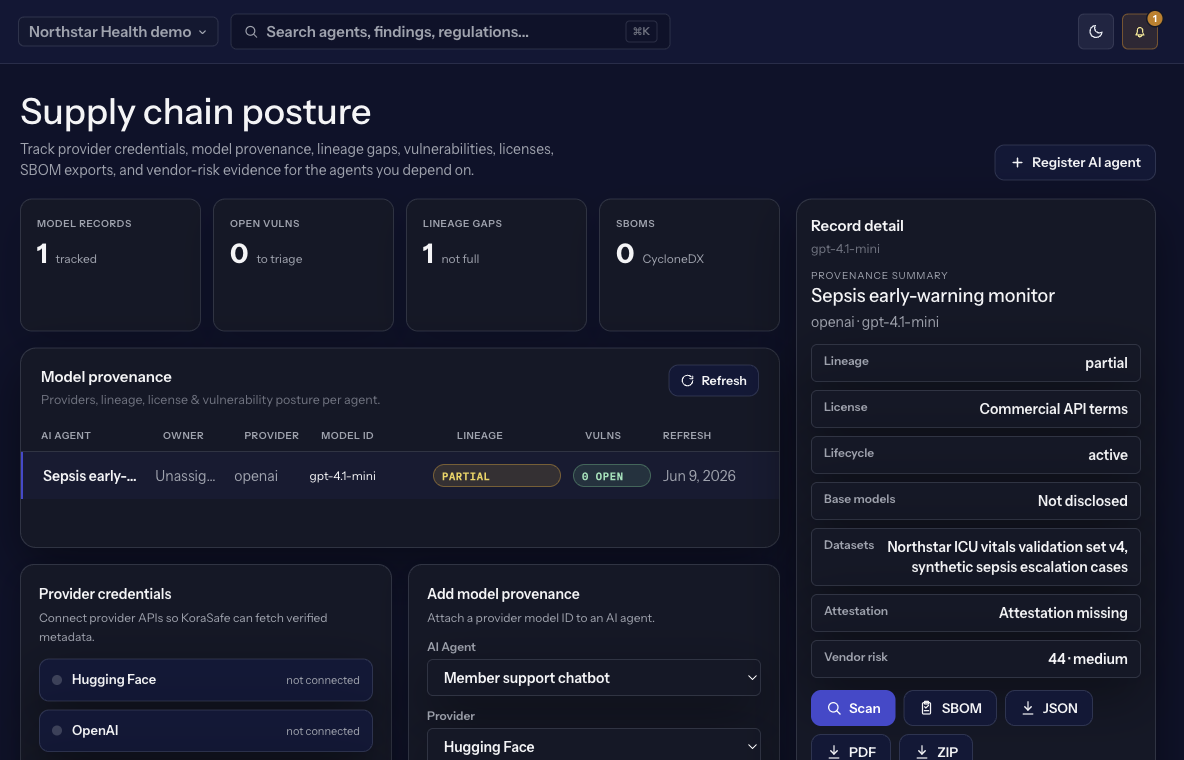
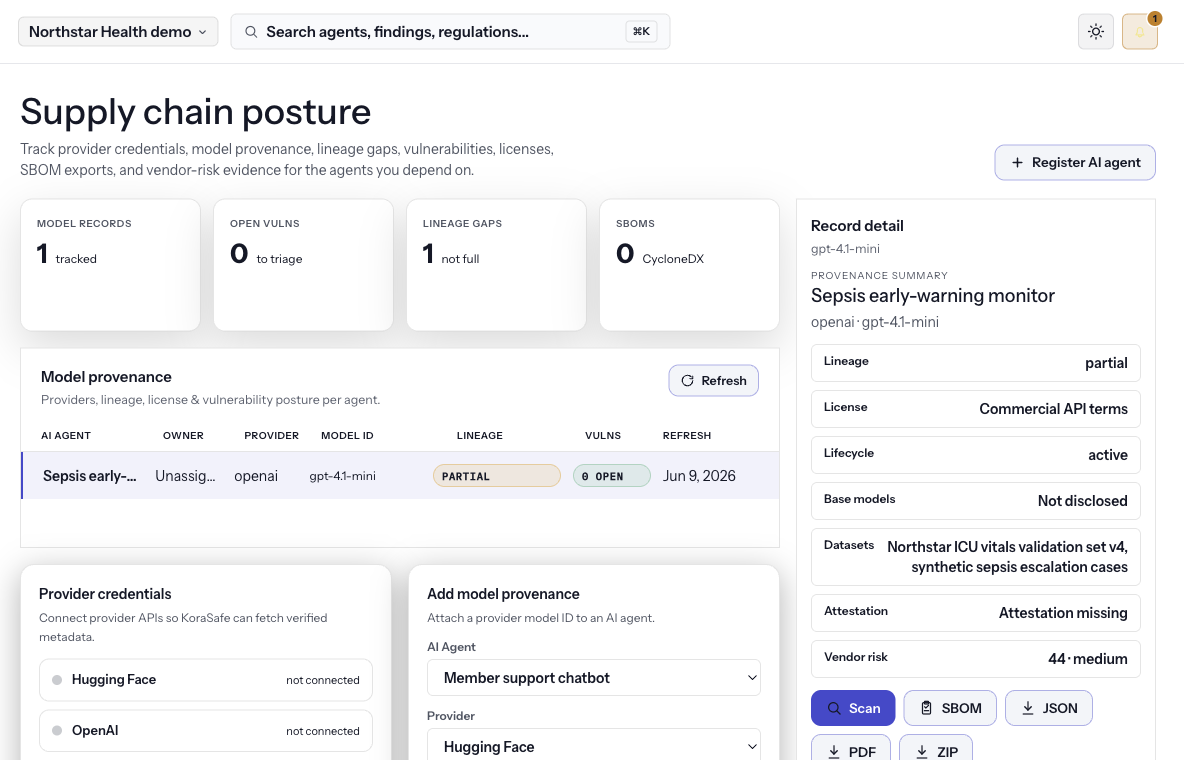
Designed against — EU AI Act Art. 11 & 13 · ISO 42001 A.6.2.5 · NIST AI RMF Govern 1.7
In the app — /inventory/supply-chain
CycloneDX AI SBOM generation
Aligned to the CycloneDX AI BOM appendix — the format auditors and regulators recognize.
Continuous vulnerability scanning
NVD and OSV scanning with CVSS-mapped severity; matched CVEs become governance findings.
Vendor risk scoring
Vulnerability history, data-handling attestation, geographic residency, and certification status.
Model provenance registration
A historical model-lineage record most organizations cannot reconstruct after the fact.
Regulator export bundle
Provenance and SBOM evidence packaged for technical-documentation requests.
Up next
Govern — apply the right policies to every agent →
Start a free trial Run a readiness assessment