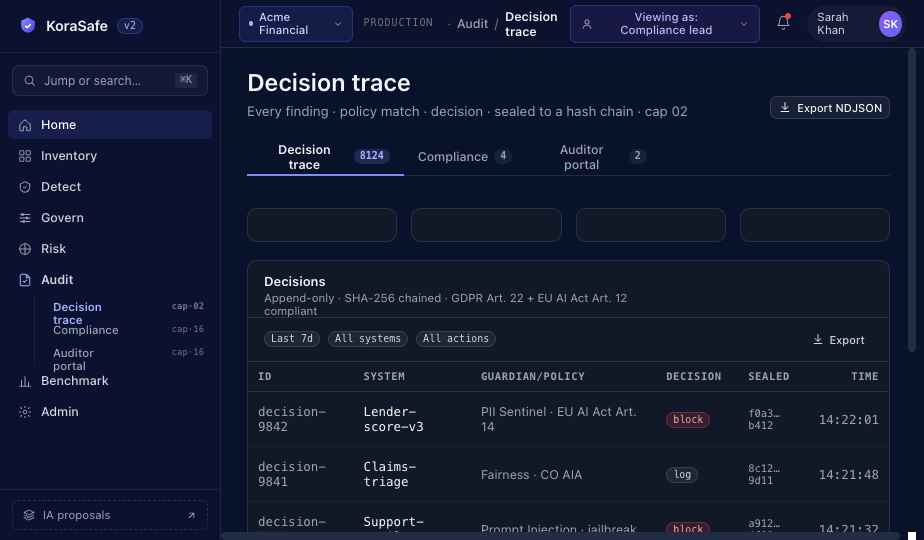
Finding to rule
Each finding names the exact policy rule or guardian condition that fired, with the input context that triggered it.
Every finding traces back through the rule that fired, the control it satisfies, and the regulation article it cites. Every AI system in your registry carries a provenance record, a signed software bill of materials, and a known-vulnerability scan. Every auditor session is time-boxed, scoped, and revocable. One platform, one chain, three audiences (your governance team, your auditor, your regulator).
Logs explain what happened. Audit trace explains accountability, which is what auditors and regulators actually ask for. Each finding chains through a minimum four hops: the rule or guardian that fired, the control it supports, the framework clause it cites, and back to the model version that produced it. Tamper-evident on the record itself; any external auditor can verify the chain independently.
Each finding names the exact policy rule or guardian condition that fired, with the input context that triggered it.
The rule maps to the control it satisfies, by control ID. Your control owners see what evidence each control is accruing in real time.
Article-level citations and cross-framework mappings (EU AI Act, GDPR, ISO 42001, SR 11-7, NIST AI RMF) so the same control satisfies obligations across multiple frameworks.
Dual-approval emergency exceptions keep their own trace separate from the main chain. When something gets bypassed in production, the audit record shows who, when, and why.
Procurement teams, regulators, and security reviewers all want the same answer: what's in the AI supply chain, where it came from, what's known about it. KoraSafe™ captures provenance per AI system, generates signed CycloneDX 1.5 SBOMs, matches against NVD and OSV vulnerability feeds, and scores vendor risk on a versioned rubric.
Signed SBOMs per provenance record in the CycloneDX 1.5 format. SHA-256 component hashes and SPDX license identifiers where the upstream source supplies them.
CVEs from NVD and package vulnerabilities from OSV match against captured provenance with exact, inferred, and false-positive confidence levels. Triage states track new, reviewed, mitigated, and won't-fix.
Each model scores against named drivers: lineage gaps, missing system cards, lifecycle warnings, license unknowns, active vulnerability exposure, metadata freshness. Bands run low through critical so risk committees can compare across models.
Hugging Face, OpenAI, and Anthropic provenance records normalize into one record shape. Vulnerability matching is wired for Hugging Face today; OpenAI and Anthropic match-paths follow as their advisory streams stabilize.
When you invite an external auditor, they get magic-link access to the evidence packets you scoped, no platform account required. Sessions expire after eight hours of inactivity; access windows close after ninety days; you can revoke either at any moment. Single-customer and multi-customer engagements run today.
Customer admins invite auditors by email. The auditor clicks once, gets a time-limited view of the evidence they were invited to review, and never needs to create a KoraSafe™ account.
Sessions expire after eight hours of inactivity. Access windows close after ninety days. Customers can revoke either at any moment from the audit settings page.
One auditor firm reviews evidence across multiple customer organizations under a single grant. Per-engagement scopes stay isolated with cross-tenant row-level security.
Inside the session, the auditor sees every engagement packet the firm has been granted for the current customer. The picker enforces grant scope; an auditor cannot see engagements they were not given.
Every auditor action (open packet, download evidence, comment) writes to the platform audit log with the auditor session ID, customer org ID, and timestamp.
Customers see active sessions, revoke individual auditors, extend access windows, and pull the audit log for the engagement from the audit settings dashboard.
Trace, provenance, SBOMs, and the auditor portal (single-customer and multi-customer engagements) all ship today. Vendor risk scoring covers license, provenance, and known-vulnerability dimensions. Vulnerability matching is wired end-to-end for Hugging Face models. Your governance team still owns the decision on which findings warrant remediation versus acceptance; KoraSafe™ captures the trace and the evidence behind each call.
Four-hop trace + tamper-evident chain + auditor PDF export
CycloneDX 1.5 SBOMs + NVD + OSV matching + vendor risk
Auditor-firm SSO + broader vendor vulnerability paths
Decision trace, hash-chained, tamper-evident, ready for any external auditor.
Start your free trial for onboarding. Trace, provenance, supply-chain SBOMs, and auditor portal access in one platform.